FIRESIDE: Far-InfraRed Extragalactic Survey and Instrument Design Exploration

Unveiling Cosmic Evolution: Developing Precursor Frameworks for Far-Infrared Science

To understand the co-evolution of black holes, stars, and the interstellar medium at and beyond cosmic noon, we must first understand how to best observe them. Bridging astrophysics and instrument design, we use a combination of semi-analytical modeling and empirical archival data to simulate the far-infrared sky and generate mock observations. This approach allows us to tackle critical observational challenges like extragalactic source confusion and establish the detectability of key spectral lines. Ultimately, by providing foundational diagnostics for star formation and AGN activity, this framework will guide the engineering and design trade-offs required to build tomorrow's transformative space observatories.


FIRESIDE Founders and Friends

We hold FIRESIDE chats roughly once a month, and we welcome interested folks in joining us on the project!

Core Team

Friends & Affiliates

David Leisawitz
GSFC
Desika Narayanan
University of Florida
Phil Hopkins
Caltech
Justin Peterson
CSUB
Amber Banks
Tufts
Aidan Cloonan
UMass Amherst

A Precursor Science Framework for Probing Cosmic Ecosystems

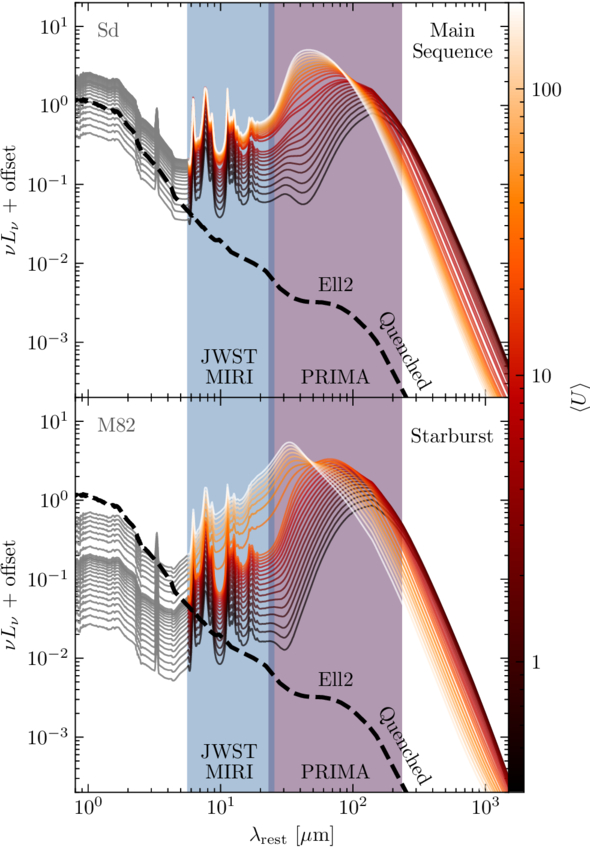
A far-infrared spectroscopic and imaging mission was identified by Astro2020 as a priority probe-class mission, but key science gaps remain in optimizing its design. FIRESIDE is a precursor science framework built to bridge those gaps—combining semi-analytical modeling with empirical scaling relations to produce realistic mock far-infrared skies, line detectability forecasts, and instrument trade studies. This comprehensive modeling establishes a general, foundational approach to far-infrared mission planning. As the community looks toward next-generation observatories like PRIMA, our data products offer critical utility for both specific probe optimization and the broader far-IR astrophysics field.

Simulating the Far-Infrared Sky

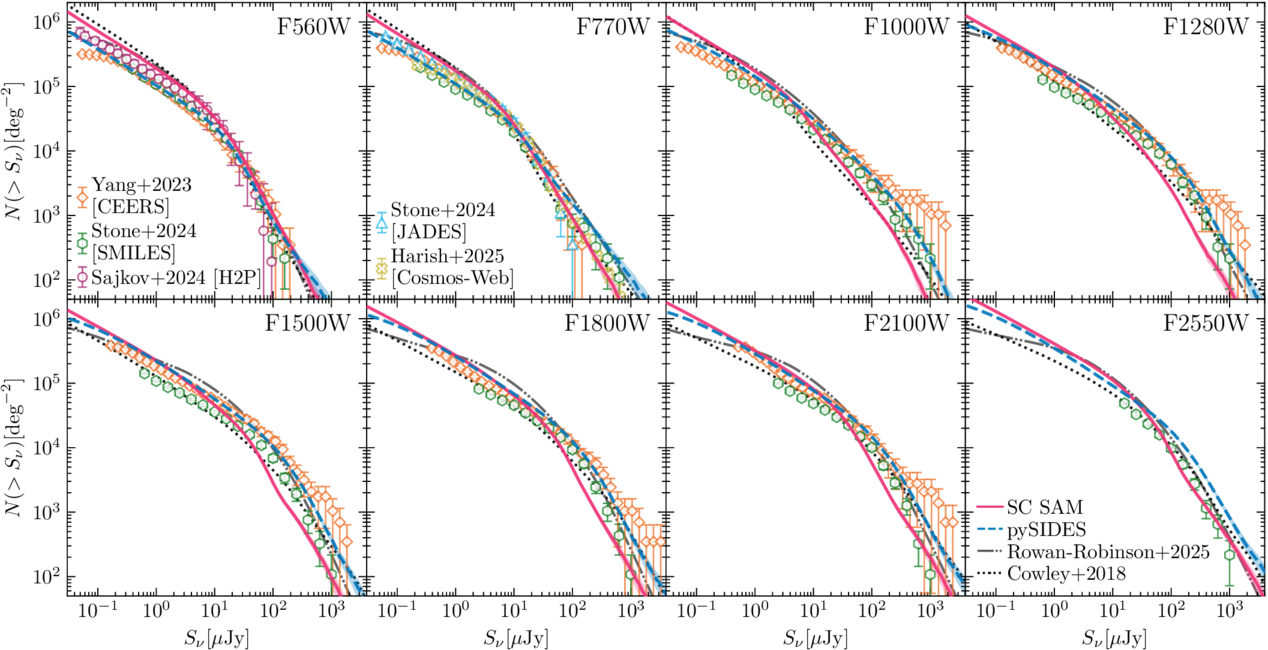
Our framework centers on utilizing a modified version of the pySIDES semi-empirical model to predict far-infrared source counts across cosmic time. As a baseline test bed for this approach, we pushed model predictions into the observed-frame 5–25µm regime to compare directly against JWST/MIRI number counts, a milestone detailed in Vidal et al. 2026 (ApJ, 1002, 23). Having successfully validated our framework against these existing MIRI passbands, we are now extending this generalized architecture to PRIMA passbands. This allows us to translate our modeled galaxy populations into forecasts for AGN spectral line detectability, survey yields, and extragalactic source confusion in the exact parameter space that matters most for future mission planning.

pySIDES MIRI Predictions

The Empirical Approach

Complementing the simulations, we build a hybrid model for the infrared luminosity function (IRLF) that links proto-spheroid/AGN co-evolution (dominant at z > 1.5) with a parametric late-type galaxy IRLF (dominant at z < 1.5), calibrated against ALMA, Herschel, and SCUBA-2 survey data. Empirically-derived far-IR line-to-continuum relations—cross-checked with CLOUDY photoionization modeling—let us convert these bolometric luminosity functions into line luminosity functions for a wide suite of far-IR diagnostics, which in turn predict survey number counts as a function of instrument sensitivity, spectral resolution, and survey depth/area (Kader et al., in prep).

The Impact of AGN on ISM Line Emission

Motivated by related observational work showing that the [C II]/FIR deficit in Type II QSOs resembles that of local LIRGs, while Type I QSOs show enhanced [C II] likely tied to additional diffuse, warm gas (Luo, Petric et al. 2025, ApJ, 981, 194), we use our SLICK line modeling of AGN-hosting galaxies in the TNG300 simulation volume to test this picture theoretically. We find that switching on AGN activity systematically boosts far-IR/sub-mm line luminosities, with the effect growing with AGN strength — a trend that holds from z = 2 to z = 4 (Garcia et al., in prep).

Survey Visualization for PRIMA

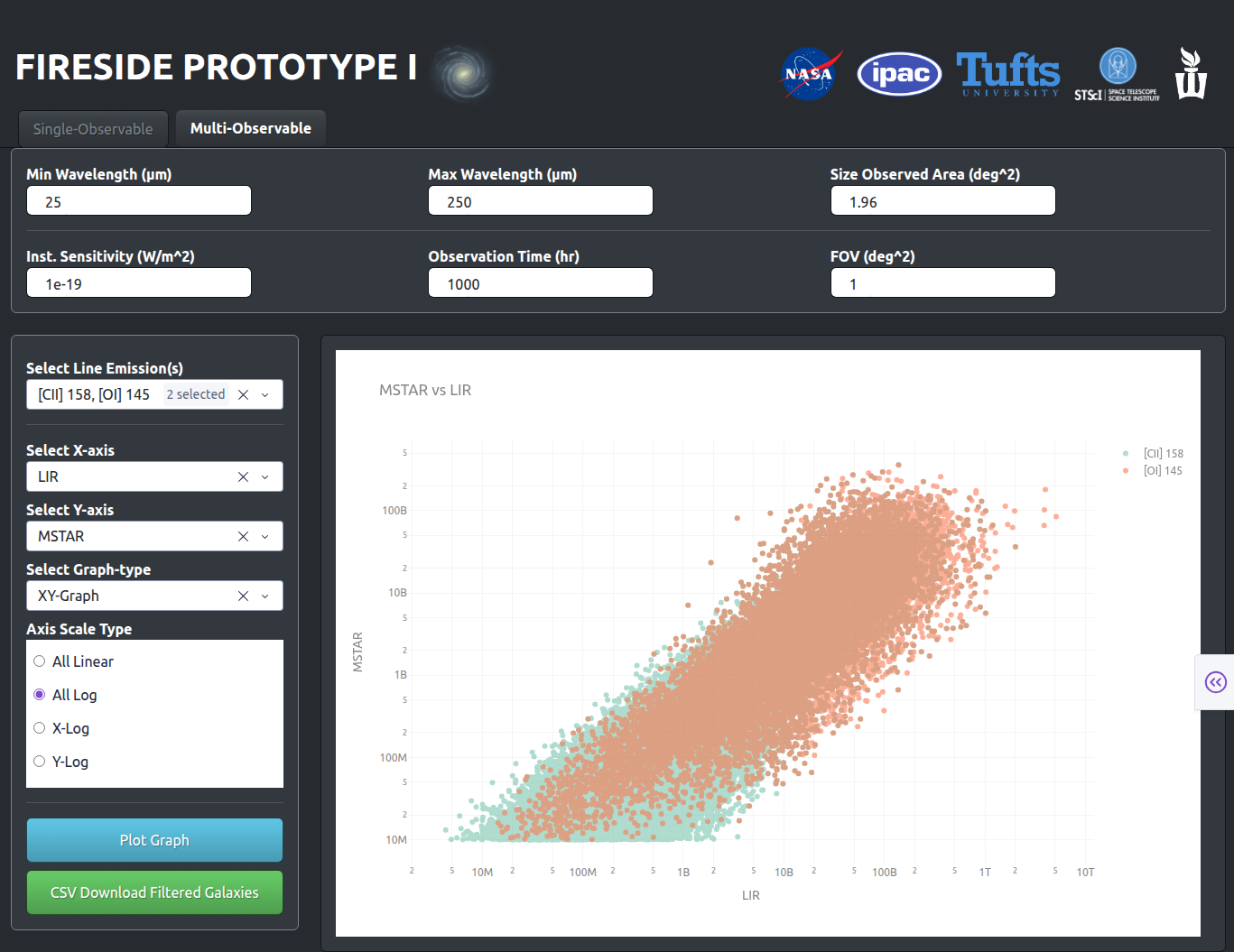
To make these predictions directly usable for mission design and the broader community, we are developing a web application that lets users interactively explore simulated PRIMA survey yields — number counts, line detectability, and confusion limits — as a function of instrument and survey design choices (Ferkinhoff, Pohl et al., in prep).

Science Result Highlights


Publication List

  1. Vidal, E.P., Sajina, A., Banks, A.R., Béthermin, M., Ferkinhoff, C., Petric, A., Pope, A., Lyu, J., U, V., Yung, L.Y.A., & Patil, P. 2026, "Modeling the JWST MIRI Counts, Insights into the Source Properties and Role of Dust-obscured AGNs", ApJ, 1002, 23 (ADS)

Additional papers from the collaboration are in preparation and will be listed here upon acceptance. Stay tuned!


Data and Tools

Mock galaxy catalogs, sky simulations, and other data products from FIRESIDE are made available to the community. Our data are hosted on CANFAR:
https://www.canfar.net/citation/landing?doi=26.0001

We also plan to host an interactive FIR survey visualization tool here as a web application — check back for updates!

Contact Us

Interested in joining our FIRESIDE chats, collaborating with us, or have questions about the project? Get in touch!
Reach us at vivianu [at] ipac [dot] caltech [dot] edu.


This work is supported by NASA ADSPS grant 80NSSC25K0169.